Subheading

Wanderlust war bereits ein mittelhochdeutsches Wort und beschreibt die Lust am Wandern, den steten inneren Antrieb, sich zu Fuß die Natur und die Welt fern der Heimat zu erschließen // A middle-high German word describing the joy of wandering, the constant urge to walk through nature and the world far from home.

Sunday, February 13, 2011

Wernigerode // a weekend in the Harz Mountains

     This weekend we ventured into the mountains. I was a little big-citied out after Berlin (fascinating city but definitely overwhelming), and ready for some hiking, a good heavy German meal, and a castle. We caught a train from Dessau to Harz (well, three trains), and by the time we made it there it was already dark. We had nothing but an overpriced map we bought at the train station (spent 4 Euros on this map, and then every time I asked someone for directions they handed me a free one, figures) and a vague memory of the hostel address. Luckily our bus driver was incredibly kind (spoke German very slowly for me), and pointed us in the right direction when he dropped us off. Had he not done so I doubt we would have found it. He had dropped us off on a quiet neighborhood road, not well-lit, and instructed us to walk about 200 m before turning right. And then I didn't quite understand him but he made motions as though walking up stairs (I've found myself playing odd games of Germenglish charades here). When we turned the corner we found ourselves crossing a small footbridge over a stream. The water was trickling quietly and we made our way down what appeared to be a private driveway, before happening upon a gate, slightly open. Once we opened the gate we saw a steep flight of stone steps winding up a hill (we had no idea how far, again, very dark). By the time we made it to the top, we saw it, a softly lit three-story building nestled in the side of the mountain--our hostel for the night.
     Checking in commenced with more charades and some choppy German, but as always we were met with patience and only a few laughs. When we went to bed that night we had no idea what to expect. We still hadn't seen the village in daylight, and had no idea how far up we were or even what was outside of our windows. And when the sun rose...wow. Looking out I saw the village wrapped around below us, a brightly-painted hub of life tucked into a tight ring of green wilderness. And straight ahead--the Wernigerode Castle.

We hiked up the mountain to see the castle (and for the sheer enjoyment of hiking), and here are some pictures I got before my camera (unfortunately) died:

Katherine leading the way.

Val, Nat, Katherine, and Brandon. A great traveling group. Although maybe Brandon wasn't quite prepared for this picture.

Wernigerode, as seen from the castle walls.

The back side of the castle (we had such a wonderful view of the front, but alas, my camera batteries did not fare that well).


A panorama courtesy of Katherine.

Thursday, February 10, 2011

Cycling along the River Elbe

     There are many things I am loving about Germany so far (Hazelnut spreads and breakfast rolls are among the top three), but the one thing I am perhaps most grateful for is the bicycle culture here, and the numerous safe, well-marked pathways. Transportation here is a world apart from what I'm used to in the Midwest. Rather than hop in your car, you walk. If walking doesn't work (meaning your destination is over 20 minutes away by foot), then you grab your bike. If biking doesn't work (perhaps over 15/20 minutes by bike), then you take the local train. And if for some reason you either don't like trains or don't know how to work the ticket machine (the second is certainly plausible, been there), then you drive. In the three weeks I've been here I know of one professor who has driven to class (once, missed the train), and that's about it. And why would you, there are separate well-marked pathways next to every road (nearly), and a number of street laws to protect both bikers and pedestrians on these paths, meaning that bike transportation is safe and convenient any where in town.
     Not to mention, out of town. Granted, all the cities are a whole lot closer here than they are at home. But the interconnectedness of these cities in our region is still pretty incredible. Lutherstadt Wittenberg lies on the River Elbe, and is just one stop on a bike trail that runs 860 km along this waterway, connecting such cities as Dresden, Magdeburg, Hamburg, and even farther into the West. And it's a beautiful trail, snaking right along the banks the whole way. I have ventured out onto the trail twice so far, although the flooding here recently has made both trips short. I made sure to take my camera the second time, so here are some photos:

A mural of the trail, too long to get all in one shot, but an idea at least.

A view of the Elbe from the trail.

Cobblestone most of the way.


Flooding along the trail, this is where the road ends for now.

My happy bike and sun coming through the clouds.

Tuesday, February 8, 2011

So viel Deutsch

Most of the time I think that learning a second language is one of the most rewarding things you can do. But there are times that learning a second language makes you want to just lay your head on your desk and call it a day.

Monday, February 7, 2011

Berlin // A story of street-art and urban planning

     This weekend we found ourselves…in Berlin. For someone who has lived in Wilmington (population 12,000) every single one of the 20 (and a half) years they’ve been alive, it was a bit overwhelming—but also fascinating, liberating, and challenging. Berlin is home to about 3.5 million people, at least ten different kinds of “native” Wurst, and the best discotheques in Europe ( it’s also worth mentioning that Kreuzberg, the Turkish neighborhood, also happens to be the place to go for the best Falafel, and for only 2.50 Euro it’s a winner).
     Unfortunately, our entire stay was cold, rainy, and windy (the kind of annoying bluster that blows your umbrella inside-out every five minutes). But fortunately, we braved the weather, traipsed through almost every neighborhood on the East side at least once (or twice), and found a couple national monuments hidden in the fog.
     Perhaps the most interesting part of our stay was the alternative tour we took on Saturday afternoon. It’s the kind of free tour that is only really advertised by word-of-mouth, and having heard about it from a friend at the Colleg, we knew to meet our two thankfully-English-speaking tour guides in front of a tucked-away Starbucks in Alexanderplatz. Our tour guide, Summer, was such a character. With her deep, booming voice, theatric story-telling, and love for back-corners and satirical street-art, she took us on a three and a half hour loop of the city. She is a native of NYC, but now lives in Berlin, blogging about street-art and hosting comedy shows and her own art gallery. Berlin is one of the most popular cities in the world for artists, of every kind really, but particularly for street-artists. Summer showed us some of the more well-known tags/artists/pieces. Following are some of my favorites:


A street-artist discussion of sorts. The first is the center stencil of the little girl. The second is an artist who calls himself "Cut & Go," tagging other works with his iconic dashed lines and name tag.


Commissioned mural with painted "windows" displaying satirical visions of Berlin. The bottom portion is free space to street-artists.

And summer in the foreground.

Along the way we saw a number of these small 4 in. square plaques commemorating the former homes and business of Jews murdered in the Holocaust. They were controversial at first because they were on the ground, and thus could be stepped on/spit on/etc. But they stayed. Because the more you walk on them the more they shine.

Street-art/mural in one of the only courtyard in Berlin that has remained in-tact in pre-WWII condition. Now an open, legal space for street-artists.

Mullet man, shows up quite a lot around the city.

Alias. Perhaps my favorite.

Summer says this mural is an anti-capitalist, anti-fascist, anti-communist end-of-the-world type piece. Obvious, right?

An old Easter block-style residence is now the canvas for "the 50 Faces." 49 more of these on each support.

     Berlin seems to be defined by a sense of haphazard transition. No one knows what it is, really. It has no defining industry or trade, no consistent design or lay-out, and an ever-changing population. It's widely known for it's street-artists, but defining a city by mostly-illegal art isn't exactly sustainable for anyone involved (particularly for the artists). To quote Summer, Berlin is just past it’s teenage years, still trying to figure out what it wants to be when it grows up. Only unified for 21 years, Berlin lacks a real “center.” Summer mentioned several times the urban-planning funk they’ve found themselves in. The city attempted to open up lots along the Spree River to large corporate offices, which the citizens contested, bringing with them a resolution to label the banks as community green space. Now the city is caught between commercial investors and citizens, green spaces and financial zones, and a past that brings with it many fault lines.

     One final image. This happened to be the last building I noticed on our tour. Pretty fitting, even today.


"The border runs not between what is above and what is below, but between you and me" --side of a building near the old East/West border


Sunday, January 30, 2011

Wir sind das Volk // A Weekend in Leipzig

     [I will warn before starting, this post ventures into historical context of Leipzig during the DDR and is cobbled together from our tour of the city and our visit to the Stasi museum; if uninterested simply scroll down to the pictures at the end].
     This Saturday we ventured to Leipzig, a larger city of about 500,000. We left early in the morning following Frühstuck (breakfast) at the Colleg. Leipzig is the biggest city in Saxony-Anhalt (our state in Germany) and is only about an hour away from Lutherstadt Wittenberg by train. Leipzig has an interesting history, and actually became a prominent city in Germany because it was a center for trade fairs. Many of the buildings in the city center (the Innenstadt) were built to house merchants and their wares and surround central market squares. Anchoring the Innenstadt are the Nikolaikirche (St. Nicholas Church) and the Thomaskirche (St. Thomas Church). Both are what you would expect of European cathedrals—towering, ornate, and centrally located.


Thomaskirche


Thomaskirche

back of Nikolaikirche (doesn't do it justice, having trouble with my zoom)


     The Nikolaikirche is particularly central, both within the Innenstadt and in Leipzig’s history during DDR times. During this era any religious affiliations were discouraged, as the socialist party saw religious loyalty as a threat. If a student was known to have been confirmed or was attending regular services they could be kept out of University and were forbidden from any government position. The Minister of State at this time actually created an entire governmental branch devoted to State Security (which really meant socialist party security), tapping phone lines, intercepting personal mail, planting spies within citizens’ families, essentially doing whatever necessary to ensure that the people of East Germany never had enough individual freedom to threaten the authority of the socialist party. The office of State Security was headquartered in Leipzig, in what is now the “Runde Ecke Museum” (round corner museum), a museum chronicling the history of the State Security, or Stadtssicherheit, Stasi for short.

     While some citizens were largely unaffected by the infiltrations of the Stasi, others attempted to flee the country. Still others remained in East Germany, and in Leipzig, peacefully speaking out against the government. This is where Nikolaikirche comes back in. Large Monday devotions were, and are, common in Germany, and often attracted those protesting the government, as churches were the only places safe from state occupation. Beginning in September 1989 East Germans joined together in what are now called “The Monday Demonstrations,” standing against invasions of privacy and abuses of freedom. Soon the Church (which seats 1700) was not large enough for the crowds, and demonstrations spilled out into the Nikolaiplatz, the plaza outside the church. On October 9, 1989 the crowd grew to 70,000. Citizens carried candles and chanted “Wir sind das Volk,” meaning, “we are the people.” The Stasi actually occupied the square at this time, and worries that it would result in public massacre thankfully did not materialize. These demonstrations eventually led to the fall of the Berlin Wall and the forfeiture of the Minister of State’s power; these demonstrations are now known as the “peaceful revolution.”

     Being in Leipzig today it is hard to imagine this past. Only twenty-two years later Leipzig is a thriving trade town, and the Innenstadt is a metropolitan force, attracting students, families, tourists, and citizens of Leipzig to a plethora of shops, restaurants, cafes, bars, museums, and yes, clubs. We spent the entire day roaming the city center, shopping and eating, and later eating and dancing. The Nikolaiplatz was perhaps my favorite part of the Innenstadt, and certainly my motivation for rambling so far into historical background in this post. In the plaza is one free-standing pillar, an exact replica of one inside the church, representing how the people brought the church outside of the church during the demonstrations. There are also small lights replacing cobblestones throughout the plaza, lighting up at night to commemorate the candles of those that took part in the peaceful revolution outside Nikolaikirche. I have a few pictures of the plaza, but they hardly do it justice.

     The people of Leipzig were friendly and fun, and excited to share their history. Following are a few pictures I was able to snap on our whirlwind tour.

sunlight shining on the back of the Nikolaikirche...

...and on the pillar in the plaza

a better view of the Nikolaiplatz


Rathaus

walking the Innenstadt


inside just one of the many old trade buildings


the oldest coffee house in the world (the coffee was delicious of course)

Thursday, January 27, 2011

Renovation // Day Two in Lutherstadt Wittenberg

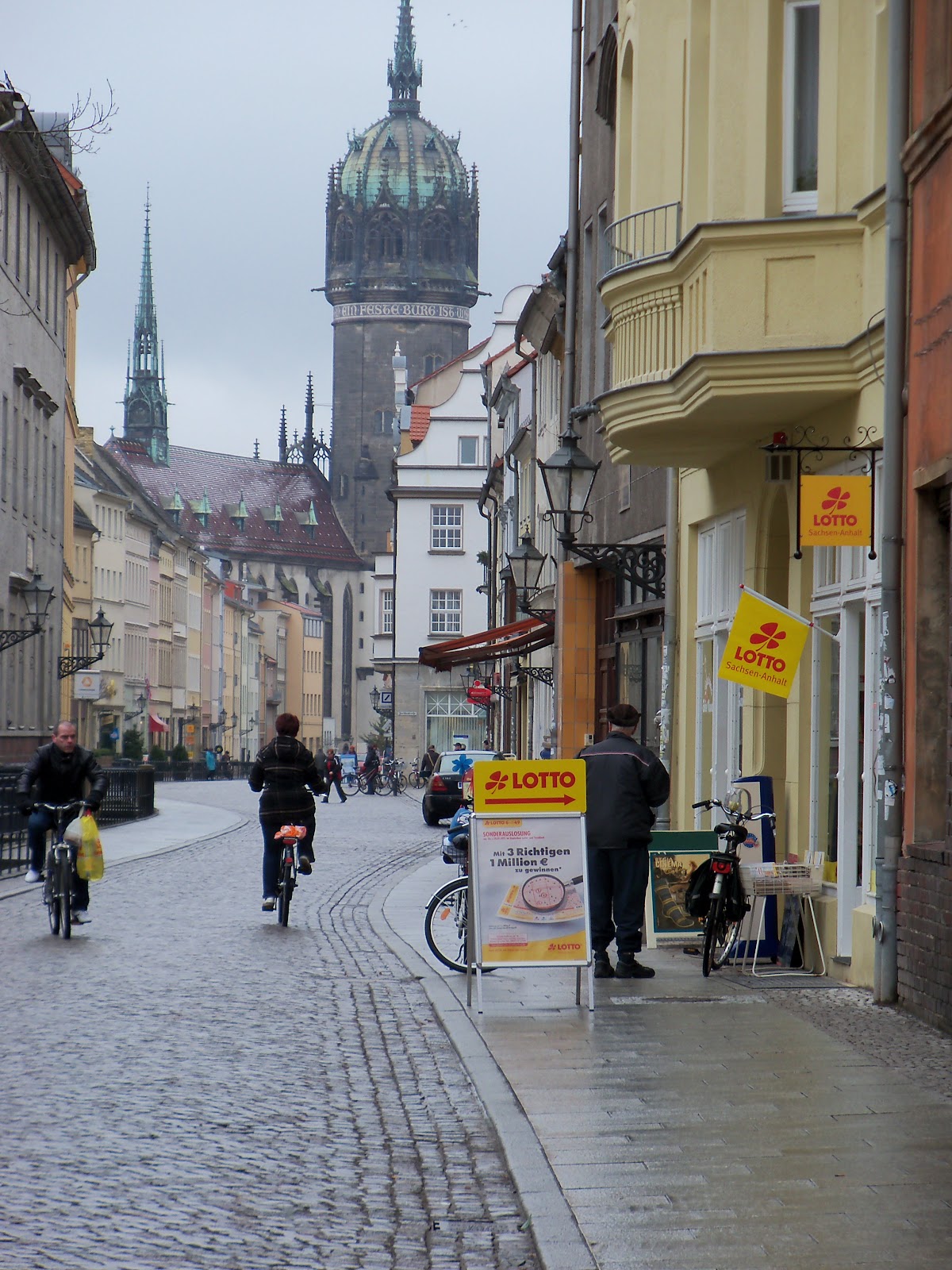
     We have been in Lutherstadt Wittenberg for two days now, and it's hard to describe everything we have encountered without thinking I've slipped back into some kind of dream. Our dorm, the "Colleg Wittenberg," is located right off of the city plaza, a criss-crossing of cobbled roads and winding alley-ways with buildings so tall they seem to form a sort of arching tunnel at times. What is most striking, for me at least, is the unique juxtaposition of historic and commercial, crumbling and renovated, medieval and modern. Wittenberg is located in East Germany, in what used to be the DDR (Deutsche Demokratische Republik), or GDR in English. The DDR was socialist until the fall of the Berlin Wall and the reunification of the German states that followed in 1990, meaning that where we are living now has only been a unified state for about 20 years. Buildings that fell into disrepair after the war were often left that way or demolished during this time, replaced by block-ish buildings unique to the DDR.
      Lutherstadt Wittenberg is an interesting part of this transition, as it is the home of Martin Luther, and thus has high stakes in Reformation history. Yet despite its history and its ongoing renovation it is aging rapidly; young people move to bigger cities and bigger universities. The university of Faust now houses us, a group of 12 American students making their way through Germany for a semester. It's unbelievable. The community is taking action, trying to make this a place of international study once more, building hostels and dormitories to bring youth from all over the world. We are their first group here for the full semester program. They are so happy to have us here, so welcoming. The mayor's assistant rode by on his bike yesterday and came to a stop to extend about five official welcomes. He couldn't stop smiling, saying how happy they were to have us here. It's incredibly humbling.

But anyways, here are some pictures: this is where we live.

Jüdenstraβe, our street

back of the "Stadtkirche," or City Church

side of the "Rathaus," or Town Hall

side-roads and bicycles, this city's canvas even on a snowy day

the "Turm" or tower of the "Schlosskirche" or Castle Church

Rathaus again

Turm again

lovely architecture

the soup bar where we ate lunch today, delicious

I ate the "Gemüsesuppe mit Hackbällchen," or Veggie soup with meatballs

city sign in front of die Stadtkirche

paradox

an empty building...

....nestled between beautifully renovated structures

Until next time, bis später.